
A parking garage clearance height is the hard limit between your vehicle’s roof and the lowest overhead obstruction inside, measured from the finished floor to the underside of beams, ducts, or fire suppression equipment.
The posted number already includes a small safety buffer, but that buffer does not account for your roof box, bike tray, or rooftop tent, which means a factory height spec will not keep you from scraping.
Most ordinary US garages post 7’0", older downtown decks can drop to 6’8", and even newer suburban structures often stop at 8’2", so a loaded Ford Transit high-roof at 8’9" or above is already ruled out before you reach the entrance.
[link-whisper-related-posts]What Clearance Height Means on the Sign
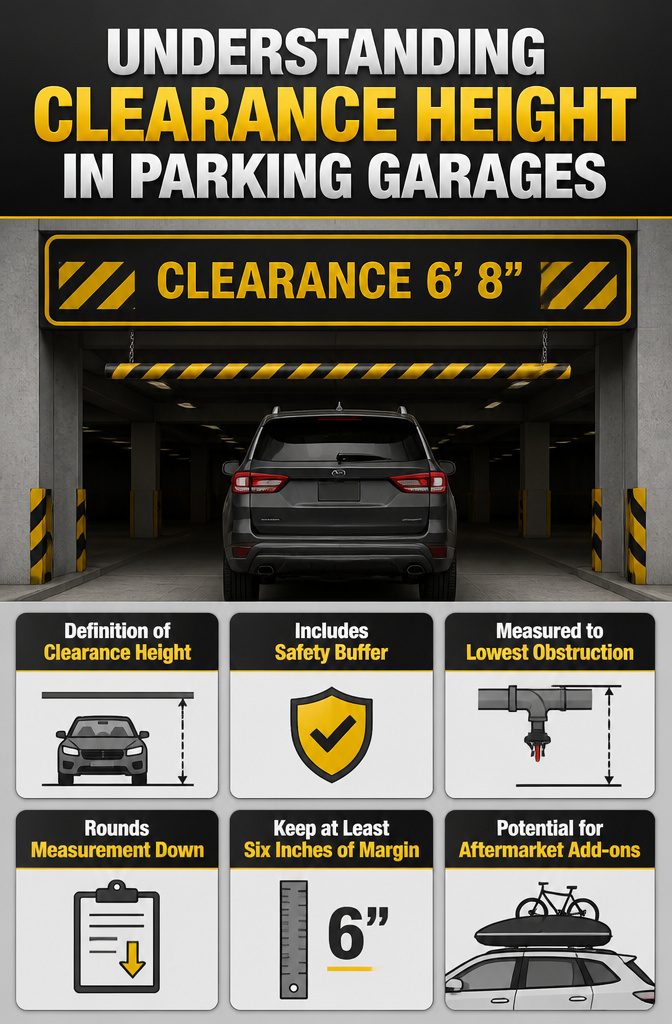
The clearance height on a parking garage sign is the lowest overhead obstruction your vehicle can pass under, measured from the finished floor to the underside of beams, ducts, or fire suppression equipment.
It is a hard limit, not a suggestion, and the posted number already includes a small safety buffer built in by the garage operator.
That buffer exists because the actual low point may ice up in winter, sag slightly, or sit lower than the clean line you eyeball from the driver’s seat.
The sign rounds the engineering measurement down, but not by much. I would never assume my roof rack or A/C shroud clears just because the factory spec sits at or below the posted number.
A factory height ignores every aftermarket add-on: roof boxes, bike trays, kayaks. Those change your true height, and the sign does not know you own them.
Measure your loaded vehicle on flat ground, add everything you carry, round up to the next inch, and keep that figure written down.
Then leave yourself at least six inches of margin below the sign. A torn-off air conditioner or peeled roof costs far more than the extra walk from a surface lot.
★ It comes with 4 Sections & Weighted base to keep it in perfect position; Portable weighted base utilizes flexible rod with flashing led light on top that flashes when contact is made with car bumper.

1. PARK IN THE RIGHT SPOT EVERY TIME – Creates a simple stopping point for your tire, helping you consistently position your car, SUV, or truck in the garage.
Ordinary Space Clearance
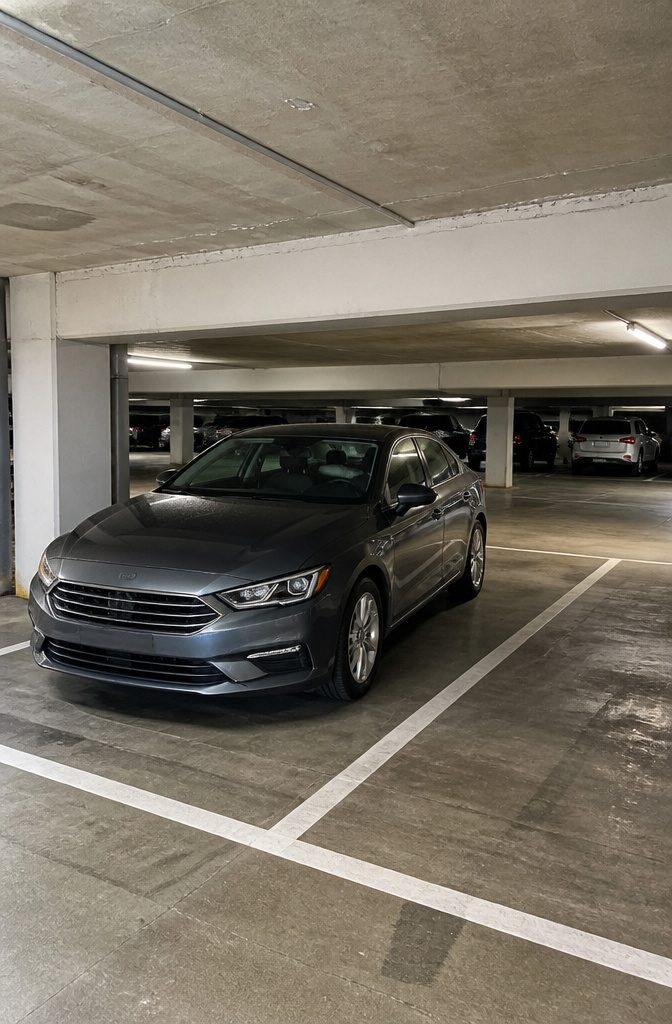
Most US parking garages set their ordinary parking spaces at 7’0" (84 inches) of vertical clearance.
That figure became the default because decades of building codes were written around sedans and compact cars, and it still shows up in both older structures and new builds that do not expect to serve trucks, vans, or anything with a roof rack.
I would not assume a garage is automatically higher just because it opened recently; the 7’0" minimum remains common wherever the architect saw no reason to spend extra height on structure, lighting, or excavation.
If you drive a standard sedan, you clear it with room to spare. If you are in anything taller, the 7’0" sign is where you turn around.

【ULTIMATE PROTECTION】With all features fully upgraded, we could confidently promise that our Asinking "Ultimate Version" Rooftop Cargo Bag will impress you with it's top-rated quality, durability and easy installation. Not only offering extra car storage room, but will protect your cargo from all harsh elements during drive, even downpours. Also, our UNIQUE new features will add more security to defeat all possible issues, especially for a long cross-country trip.
【UNIVERSAL FIT】With adjustable angle structures, it's universal for all sorts of car door latches and compatible with all vehicles in both front and rear doors. The heavy-duty scissor lock structure with bidirectional forces makes the connection very tight and safe. Great ladder accessory for your roof rack.

Universal Fit: it's universal for all sorts of car door latches. Updated design, multi gear adjustment horizontal angle, you can complete all operations on the roof at a more comfortable height.
ADA Van-Accessible Route Clearance
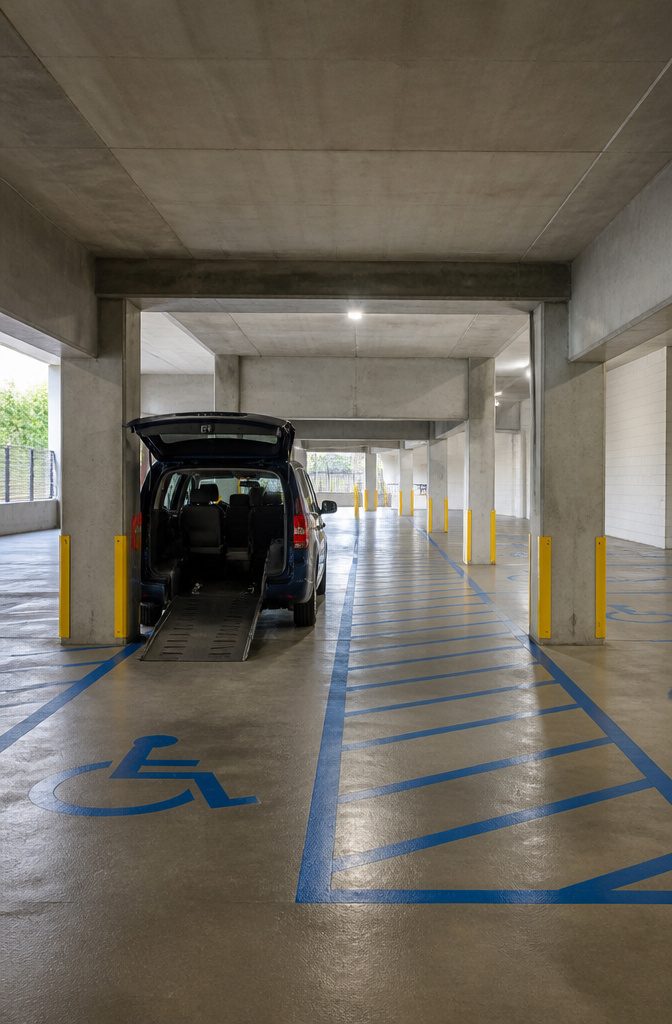
The 8’2" (98 inches) minimum for ADA van-accessible routes applies to the driving path itself, not just the parking space and its access aisle.
A wheelchair-accessible van with a raised roof or a deployed lift needs that clearance overhead to pass through safely, which is why the federal 2010 ADA Standards set this figure higher than the 7’0" typical for ordinary spaces.
Some states go further; California applies the 8’2" rule to every accessible space, not only van-designated ones.
When I am checking whether a garage works for a high-roof accessible van, I look past the posted clearance at the entrance and trace the full route to the reserved space.
The drive aisle matters as much as the parking spot, and a garage that clears 7’0" everywhere else still fails if a beam or duct drops lower along that path.

The unique Y-shaped design makes it easy to install and bundles tools, and locks it perfectly

APPLICABLE SIZE: The design of heavy-duty straps with reliable buckles for quick release rubber clamp mount allows it to be adjusted to fit different sizes of tools. Quick-release rubber clamps mount can secure tools with diameters ranging from 29mm to 36mm. Roll bar clamp mounts bar mounting bracket kit fits for 1" 1.5" 1.75" round bars, ATV UTV rack, roll bar and other round tube. Note: Please double-check the size before ordering

Older Downtown Deck Heights
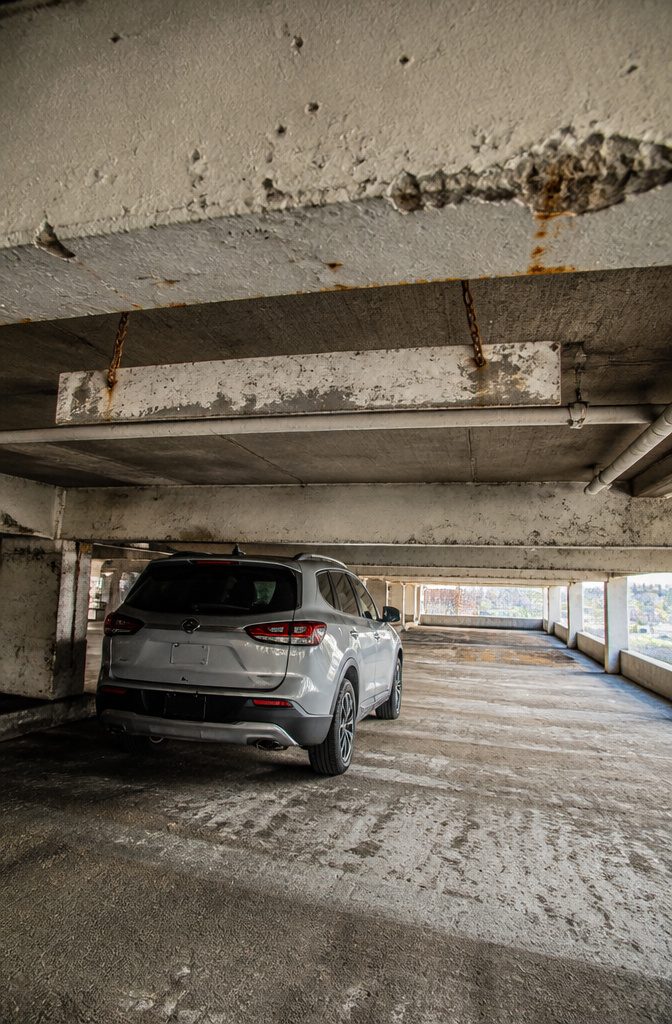
Older downtown parking decks sit in a 6’8" to 7’6" range that will swallow most sedans but eats a surprising number of modern SUVs and trucks.
These structures went up before tall vehicles became the default American family car, and the tight clearances remain because downtown land costs made every inch of vertical space expensive to build, retrofitting a standing structure runs into serious money, and the original construction methods simply did not anticipate today’s full-size profiles.
I would not assume a posted 7’0" leaves comfortable margin; roof racks, antennae, and the slight slope of entry ramps all steal real inches.
A Ford F-150 or Chevy Suburban at stock height already brushes against the low end of this range, and anything lifted or carrying cargo up top becomes a genuine scrape risk.
The posted sign at the entrance is the number that matters, but in these older decks I treat anything under 7’6" as a hard pass unless I have measured my own vehicle myself and found two or three inches of daylight.

Efficient Heating: Heater Power: 2 KW; Rated Voltage: 12 V & 24V. Applicable Range: 108-161 ft²/10-15 m². VEVOR diesel air heater adopts a sandblasting aluminum heat exchanger for rapid heat production and transfer, ensuring a comfortable temperature inside your vehicle or boat within 10 minutes.

Efficient Heating: Heater Power: 2 KW; Rated Voltage: 12 V. Applicable Range: 108-161 ft²/10-15 m². Our diesel air heater adopts a sandblasting aluminum heat exchanger for rapid heat production and transfer, ensuring a comfortable temperature inside your vehicle or boat within 10 minutes.

Efficient Heating: Our diesel heater fuel pump ensures optimal fuel delivery, maximizing the efficiency of your heating system
Modern Suburban Garage Heights
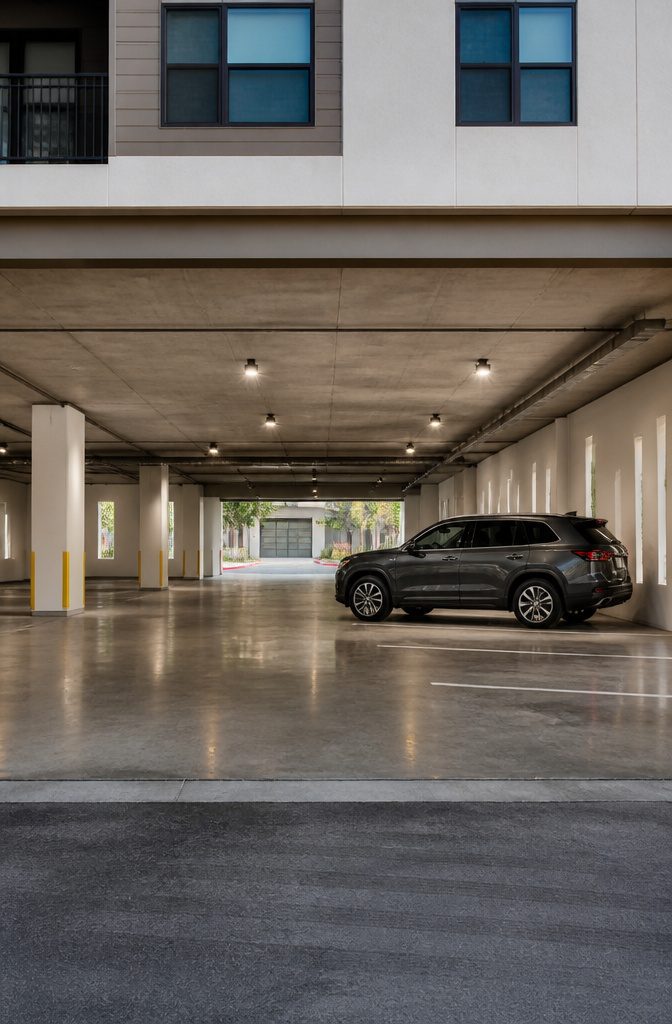
Newer suburban and retail parking garages typically post 7’6" to 8’2" of clearance, a jump that reflects how vehicle heights have shifted over the last few decades.
These structures are built around the sedans, crossovers, and light trucks that dominate driveways now, not the lower-slung cars of the 1980s and 90s.
The extra headroom also leaves breathing space for ventilation ducts, sprinkler lines, and cable trays that newer fire and mechanical codes require overhead.
An 8-foot ceiling sounds generous until you stack it against a roof rack, a lifted suspension, or a fiberglass topper.
The owner of a modified Toyota 4Runner with an OME lift and adventure rack learned this in San Francisco, where even 7.5 feet is rare downtown and his go-to became street parking near the Embarcadero.
In the suburbs, though, that same truck slips through fine.
I would take the posted number at a modern garage seriously but not fearfully: it is usually the real limit, not a conservative rounding, because the engineer already accounted for the ductwork.
If your rig sits stock, you are almost certainly safe.
If you have added even a few inches, the difference between a modern suburban garage and an older downtown deck is the difference between an easy pull-in and a very expensive scrape.

GARAGE CAR STOPPER 2-PACK - Parking in a tight spot without damaging walls or your vehicle is easier than ever with this 2-pack of 16-inch-long car stoppers for garage. Each parking block installs easily so you can park perfectly every time.
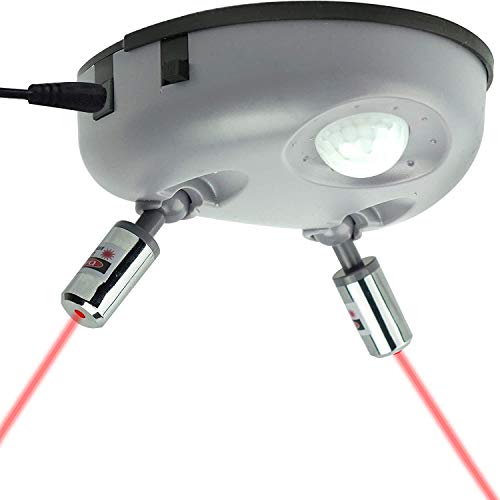
► MOTION SENSOR – The Zone Tech dual laser guide eliminates the dangers that come with not parking in an encased parking spot or carport. The motion sensor identifies movement up to 10 feet away.

360 Degree Adjustable Dual Laser Beams: this garage parking aid assist features two adjustable laser beams that provide precise visual guidance for proper parking positioning every time, with the dual laser design accommodating two cars in a shared garage, making it nice to navigate cramped parking spaces and simplifying daily parking routines for households with multiple vehicles
Airport and Mixed-Use Structure Heights
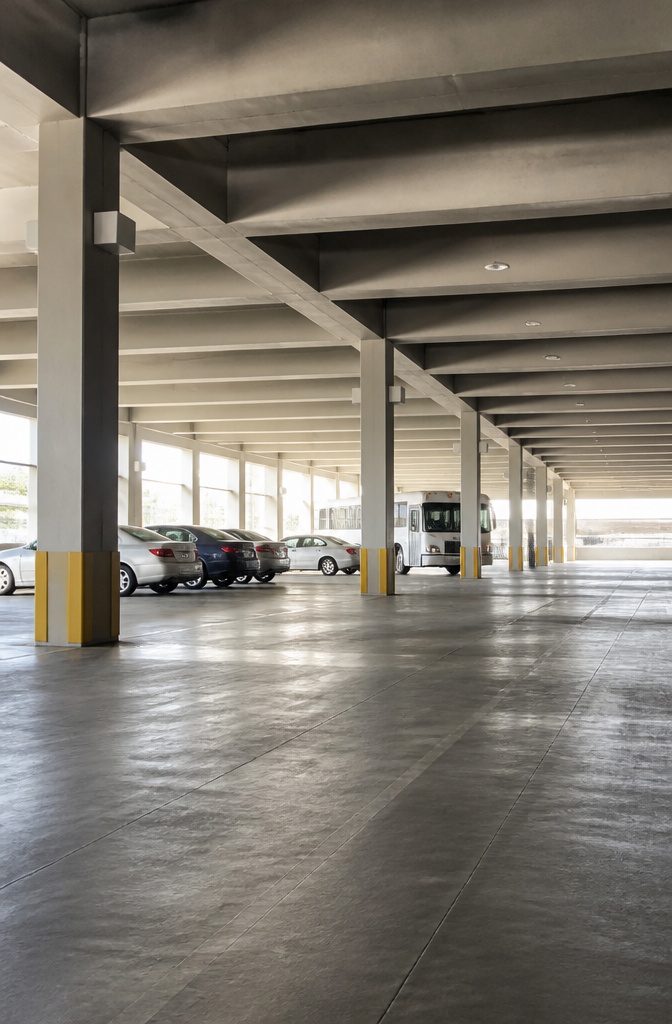
Airport and mixed-use garages sit in the 7’0" to 8’2" range, but consistency is not their strong suit.
A structure built for rental-car returns, patient drop-offs, and hotel shuttles ends up with different clearances on different levels, sometimes even at different entrances, because the vehicle mix changes that much.
A passenger van at roughly 6’8"–7’2" might sail through one ramp and scrape on the next if that section was sized for sedans.
Shuttle buses need the high end of the range, so newer airport construction tends toward 8’0" or 8’2", but retrofitted wings or older short-term parking can hold to the 7’0" minimum.
The posted sign at the entrance is the number that matters, and in these facilities it is worth reading even when you have been through before.
I would not assume clearance carries from one level to another in a mixed-use deck.
Hospital garages are especially prone to splits: staff parking sized for personal vehicles, visitor decks handling vans, and separate bus loops with their own height limits.
If you are driving anything taller than a standard crossover, the safe move is to treat each new entrance as its own check.

【𝙁𝙍𝙐𝙎𝙏𝙍𝘼𝙏𝙀𝘿 𝙒𝙄𝙏𝙃 𝙒𝘼𝙏𝙀𝙍 𝙇𝙀𝘼𝙆𝙎 𝙊𝙉 𝙏𝙃𝙀 𝙍𝙊𝘼𝘿】Based on 10 years of exploration and 1,000+ quality improvements across 15+ series of car roof bag, we could proudly promise our Asinking roof rack cargo carrier bag is 100% rip-proof and waterproof. Made from 900D abrasion-resistant PVC and featuring triply reinforced heat-welded seams and strong zipper, it makes your luggage from downpours and scratches, ensuring durability in harsh conditions.

TAKE YOUR GEAR BEYOND THE VEHICLE: Innovative compact cargo box designed to be removed from your rooftop setup and transported directly to your destination. Built-in wheels and a handle make it easy to move gear while keeping everything organized inside the box.

[ROOF GEAR CASE]Rugged design for high durability. Low profile with square design for larger capacity. Side handle for easy opening / closing and carring
High-Roof Van Clearance Needs
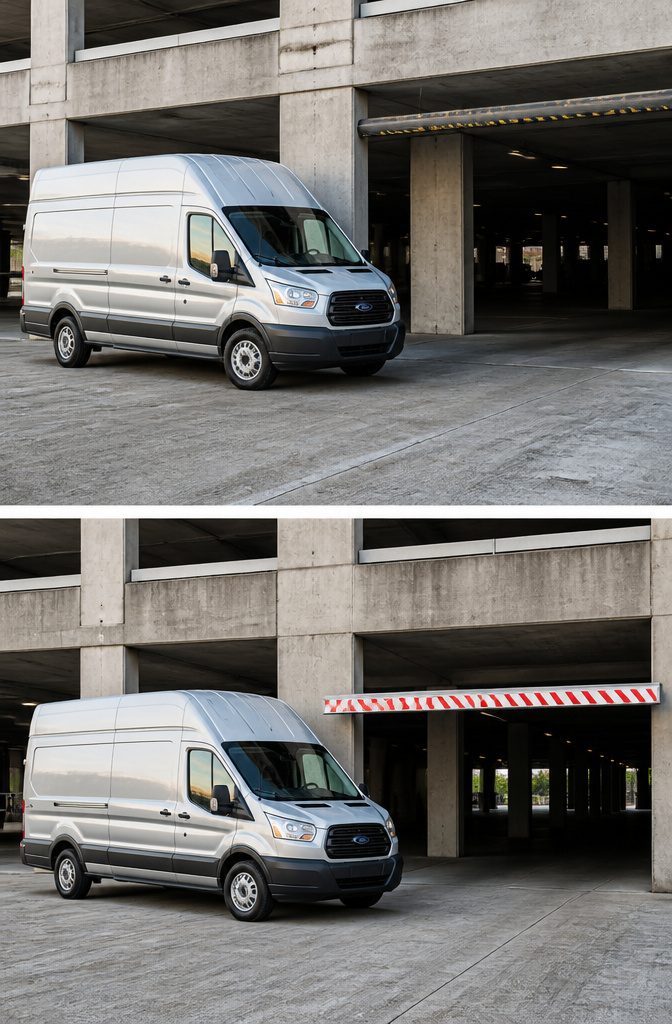
A Mercedes-Benz Sprinter or Ford Transit high-roof van stands 8’9" to 9’4" at the roofline, well above the 7’0" to 8’2" clearance posted at most parking garages.
That extra height comes from the factory raised roof these vans are built with, a feature commercial buyers want for standing room inside and a growing number of weekend builders want for camper conversions.
I would not bother pulling into a standard garage with one of these.
Even medium-roof cargo vans at roughly 8’0" to 8’6" are a close call that depends on the exact sign, and the high-roof models blow past that buffer entirely.
Roof racks, vent fans, or solar panels added after purchase only make the mismatch worse, though the stock height alone is already enough to rule most structures out.
Your practical options narrow quickly.
Open-air surface lots work. So do specialized fleet or commercial facilities built with taller bays, though those are not always open to the public.
For anyone converting a high-roof van into a living space, I think the parking question should shape your build from the start: the vehicle becomes a machine that does not fit the infrastructure most people take for granted.

✅ Precision Fit: Exclusively designed for Ford Bronco 2021-2025 with OEM-grade measurements. Every product is tested to ensure a perfect fit.

*DO NOT OVER TIGHTEN!* The attached ratchet tie down ensures the roof bar will remain firmly on your car top. Please be careful not to over tighten.

Comprehensive Wire Protection: This LB wire pulling guide wraps wires securely during routing. It stops severe bending, jamming and abrasion while guiding cables smoothly through conduits.
Class B Camper Van Clearance Needs
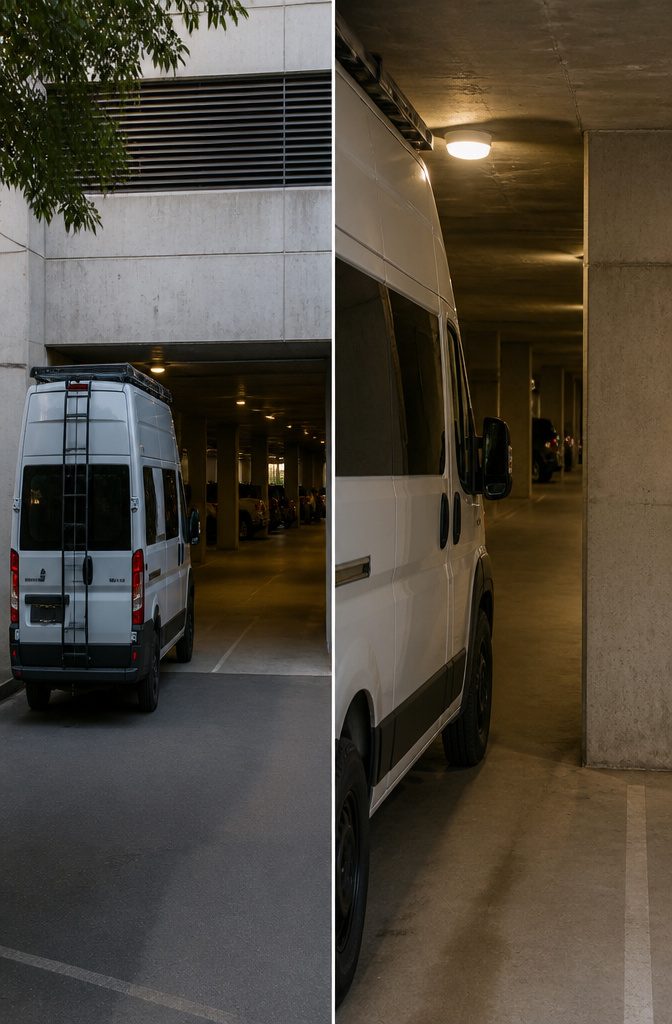
A Class B camper van sits in that awkward middle ground, taller than anything in a standard lot but short enough that owners sometimes convince themselves they’ll squeeze through.
The honest range is 8’6" to 10’0", and that is already past the 7’0" clearance most garages post. I would not bother driving one into any structure without an explicit oversized-vehicle sign.
The spec sheet number is not the number that matters. Roof-mounted AC units, vent fans, and solar panels each add inches the manufacturer height does not include, and those inches are where the expensive crunch happens.
I have seen owners map surface lots and street parking before trips for exactly this reason; it is the practical habit that saves the roof.
Look for dedicated oversized-vehicle parking instead of hoping the sign rounds down. The stock height alone puts these vans in "no" territory against standard garages, and the added gear only pushes them further past the line.

【SPECIFICATIONS】-Heater power: 5KW; Fuel gasoline: Diesel; Rated voltage: 12V; Fuel consumption: 0.2-0.5; Working temperature of the heater: -40℃~+50℃; Working temperature of the oil pump: -40℃~+40℃

【75MM DIESEL HEATER DUCT KIT】 Designed for many 2KW, 5KW and 8KW diesel parking heaters, this warm air duct kit helps route heated air from one heater outlet to two separate areas. Please measure the heater outlet and confirm the required 75mm duct diameter before ordering.

2kW 0.18-0.35L/h Consumption: Power: 2kW; Combustion Efficiency:≥90%. Fuel Tank Capacity: 2L. Our portable diesel heater is made of a cast aluminum body and ceramic igniter. It delivers rapid heating in cold conditions, consuming only 1 gallon of diesel per night to maintain warmth across a large area.
Class C RV Clearance Needs
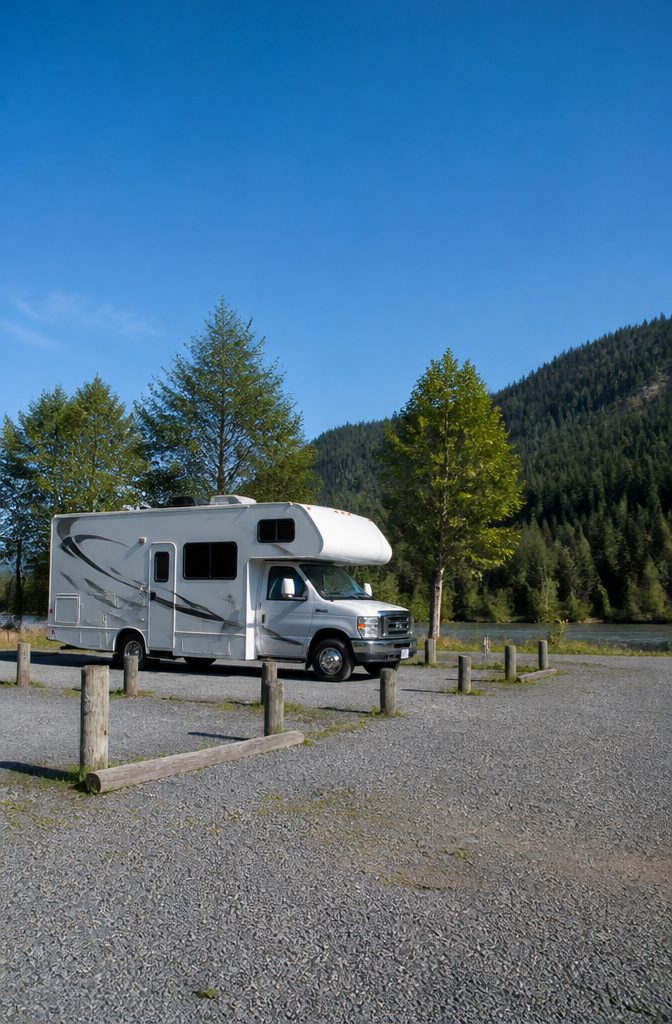
Class C RVs run 10’0" to 11’6", which puts them well past the ordinary parking garage ceiling.
The overcab sleeping area is what drives this height, that box above the cab adding a foot or more that standard structures simply never planned for.
Typical US garage clearances sit around 7’0", and even the more generous ADA van-accessible routes only reach 8’2". A Class C owner is not squeezing through either gap.
That leaves surface lots, dedicated RV parking, and campgrounds as the practical choices.
I would skip any hope of tucking a Class C into a mixed-use structure or airport garage even if the entrance looks tall; the posted number is what matters, and posted numbers assume passenger vehicles.
The real move is to phone ahead to a surface lot near your destination and confirm they can take your exact height, or to plan around campgrounds with shuttle service.
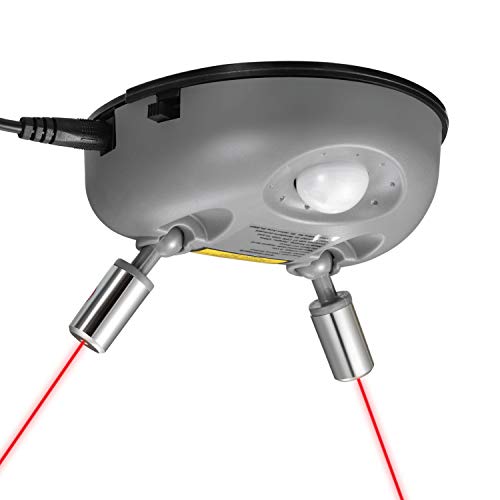
[New Wider Angle Upgrade] This updated product from Fosmon is perfect for a one or two car garage. The angle of the two lasers is widened up to 75 degrees, which can safely and efficiently assist two cars.

Accurate Guidance: This parking assist device is equipped with a laser beam that clearly marks the correct parking position. By providing a precise visual guide, it helps drivers avoid collisions with obstacles like trash cans or walls, thereby preventing vehicle damage and making parking safer and more reliable

[High Quality Material] The car parking sensor is made of ABS material, which is lightweight and not easy to deform, break, rust or decay. It can maintain good condition even in humid environments in the garage, providing you with long-term application.
How to Measure Your Vehicle
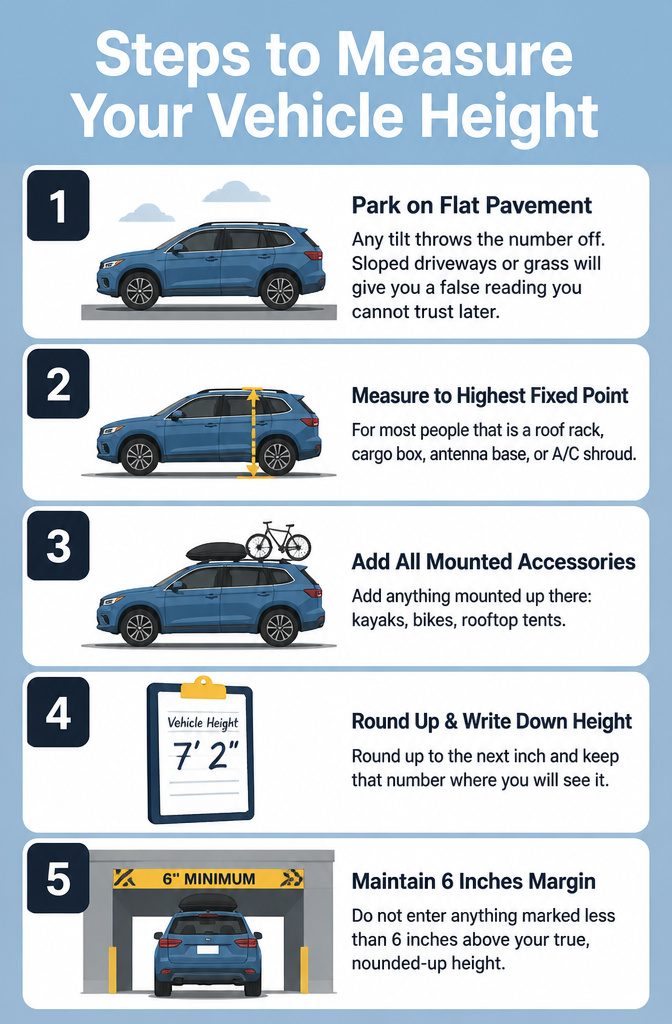
- Park on flat, level pavement. Any tilt throws the number off, and sloped driveways or grass will give you a false reading you cannot trust later.
- Measure from the ground to the highest fixed point on the vehicle. For most people that is a roof rack, cargo box, antenna base, or A/C shroud. Add anything mounted up there: kayaks, bikes, rooftop tents. Factory spec sheets almost always exclude these, so a published height is only a starting point, not your real height.
- Round up to the next inch and keep that number where you will see it. I keep mine on a card in the dash. Posted clearances are the lowest beam or pipe in a structure, and that point may sag, ice over, or sit lower than the sign suggests. I would not enter anything marked less than 6 inches above my true, rounded-up height. The five minutes with a tape measure costs nothing; a torn-off rack or peeled roof costs plenty.

[Intelligent Fingerprint Sensor & Dual Security] Say goodbye to keys. Our capacitive fingerprint sensor features ≤0.5s response time and 99% recognition rate, supporting up to 20 fingerprints. Includes an emergency mechanical key and an extra front‑located secondary lock for driving safety.

【100% Waterproof & Heavy-Duty Material】 Made with upgraded durable 840D PVC material and high-frequency welded seams, features a double-layered waterproof cover, this rooftop cargo carrier keeps your luggage dry even in heavy rain, snow, or long-distance travel. Built for road trips, camping, and family vacations.

【Large Capacity & Universal Vehicle Fit】 The rooftop cargo carrier bag delivers 20 cubic feet of storage with 51’’×39’’×17’’ dimensions, easily holding suitcases, travel luggage, sleeping bags and outdoor gear. It mounts quickly with included hooks and works with or without roof rails, fitting all sedans, SUVs and trucks. Perfect for family camping, road trips and cross-country moving.
Why Garages Vary by Age and Type
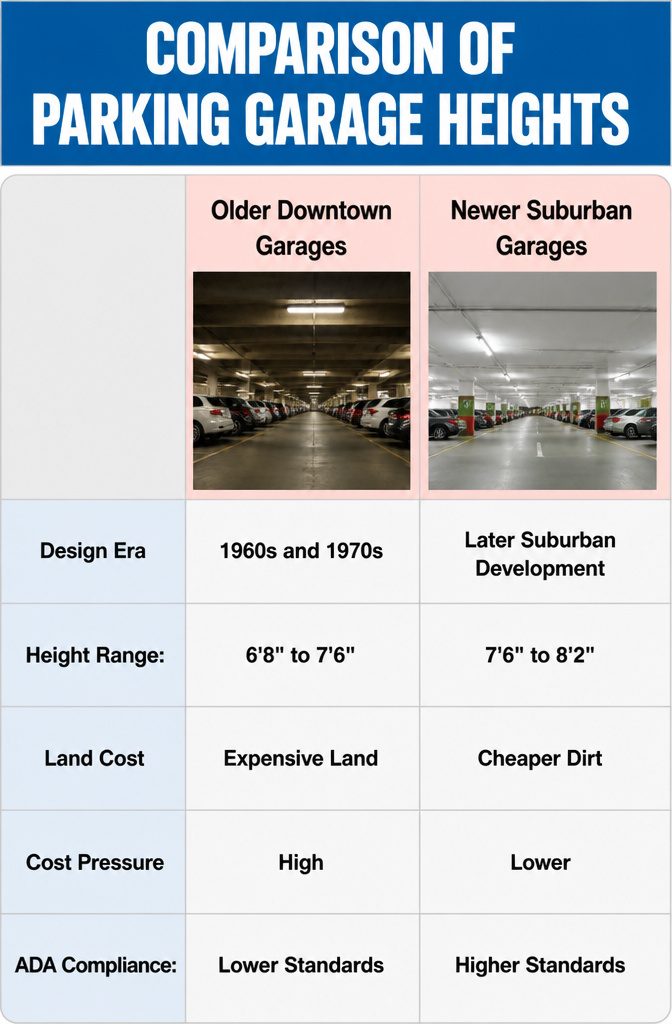
Parking garage design tracks the vehicle it was built to serve. Downtown structures from the 1960s and 1970s sit on expensive land, so builders squeezed floor heights to 6’8" to 7’6" and packed in more levels.
Suburban garages built later, on cheaper dirt, could afford 7’6" to 8’2" without the same cost pressure.
Codes followed the same arc: the federal ADA minimum for van-accessible routes now sits at 8’2", up from what earlier standards allowed, because vehicles grew and accessibility expectations changed.
That same shift is why newer mixed-use buildings, even at airports, tend toward the taller end of the range.
An older downtown deck might clear a compact sedan fine while a modern SUV or high-roof van scrapes; the structure was never wrong, just built for a different mix.
What saves you a headache is checking the posted sign at the entrance, not assuming the decade or neighborhood tells you enough.
Frequently Asked Questions
What is the minimum parking garage clearance height?
The minimum is 7’0" (84 inches) for ordinary parking spaces under typical US codes, and 8’2" (98 inches) for ADA van-accessible routes under federal rules.
Older garages can dip lower, with some downtown decks posting as little as 6’8". The sign at the entrance already includes a small safety buffer, so treat the posted number as a hard limit.
Will my vehicle fit in a parking garage?
It depends on your vehicle’s true loaded height versus the posted clearance.
Measure from flat ground to your highest fixed point, add roof racks, cargo boxes, or anything mounted up top, round up to the next inch, and leave at least six inches of margin below the sign.
Factory spec sheets exclude aftermarket gear, so a published height is only a starting point.
How do I find a parking garage that fits my vehicle?
You can enter your vehicle’s height on platforms like WillIFit.ai, which shows garages, tunnels, and low bridges that clear it across 226 US cities.
Many listings are AI-verified from Google Street View signage. Your own measurement card in the dash works as a quick backup check against any posted sign.
Will an F-150 fit in a parking garage?
A stock Ford F-150 already brushes against the low end of older downtown decks, which often sit at 6’8" to 7’0".
Modern suburban garages at 7’6" to 8’2" handle a stock truck fine, but anything lifted or carrying cargo up top becomes a scrape risk. Measure your specific rig and leave six inches of margin below the posted sign.
Do most trucks fit in parking garages?
Most stock trucks and SUVs clear modern suburban garages at 7’6" to 8’2", but struggle in older downtown structures posted at 6’8" to 7’0".
The problem grows with roof racks, toppers, or lifted suspensions. A modified Toyota 4Runner with a lift and adventure rack, for example, could not fit any downtown San Francisco garage and defaulted to street parking.